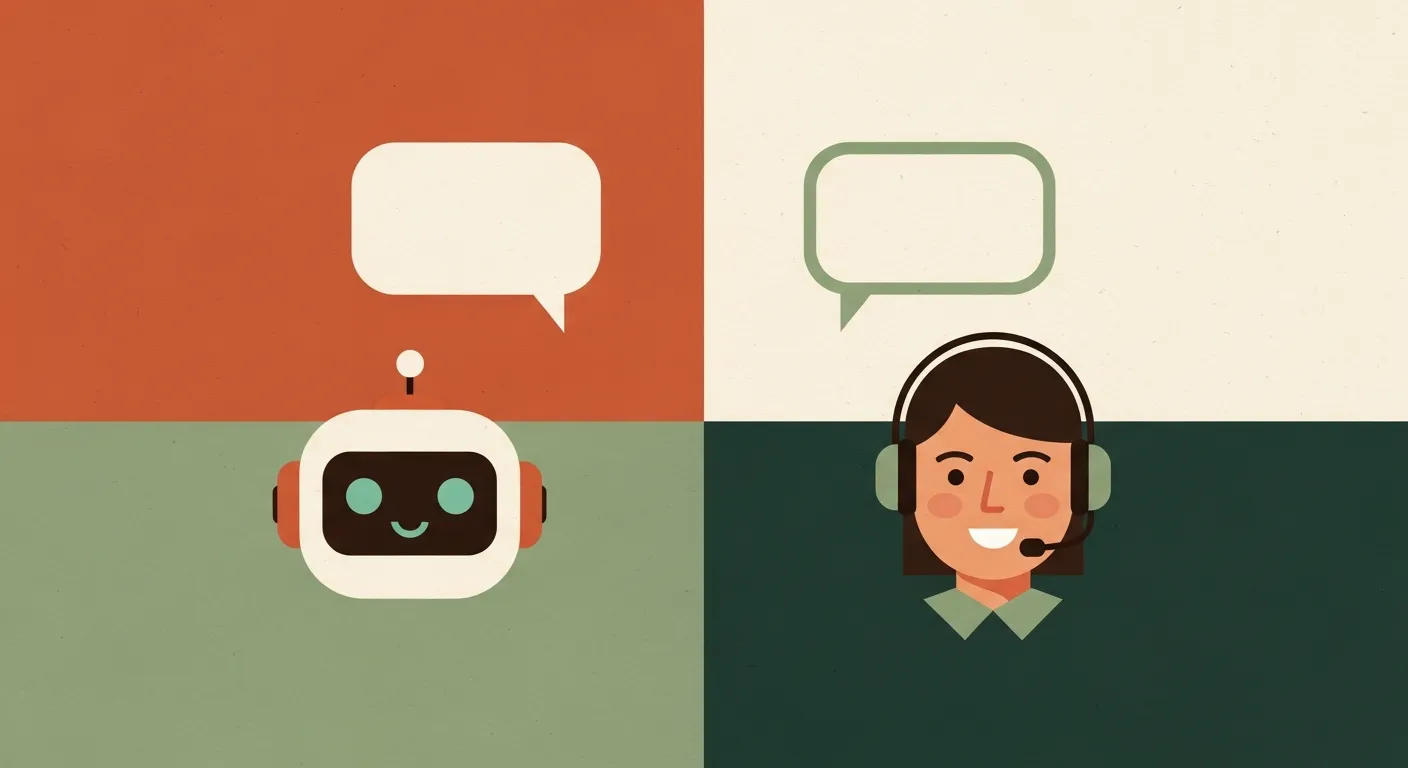
The core difference
Live chat connects a visitor to a human on your team. It's powerful and personal, but it only works when someone is available to respond. The moment your team logs off — nights, weekends, lunch breaks — live chat becomes a contact form.
An AI chatbot answers on its own, instantly, around the clock, using the content you've trained it on. It never sleeps and handles unlimited conversations at once, but it's only as good as what it knows, and some conversations genuinely need a person.
Cost and team size
Live chat costs scale with people. To cover business hours you need staff watching the queue; to cover more hours you need more staff. For a small team, that's the real expense — not the software.
An AI chatbot has a flat, predictable cost regardless of volume. One bot can handle ten conversations or ten thousand without you hiring anyone. That's why chatbots are especially attractive to small teams who can't staff a live queue all day.
Response time and coverage
This is where chatbots win cleanly. Visitors expect near-instant answers, and most buying questions happen outside of business hours. A bot replies in seconds, every hour of every day. Live chat can match that speed only while staffed — and a slow live-chat reply often frustrates more than no chat at all.
Customer experience and trust
Here live chat has the edge for complex, emotional, or high-stakes conversations — a frustrated customer, a big-ticket sale, a nuanced complaint. People still value reaching a human when it matters.
The mistake is treating it as either/or. The best experience is a bot that handles the repetitive 80% instantly and hands off the important 20% to a human with full context, so nobody has to repeat themselves.
So which should you choose?
Choose an AI chatbot first if you're a small team, you get the same questions over and over, or you're losing leads after hours. Choose live chat if you have staff to cover it and your conversations are mostly complex or sales-heavy. For most growing businesses, the answer is both: let the bot cover everything by default and escalate to a person when needed.
- Small team, repetitive questions, after-hours traffic → start with an AI chatbot
- Staffed support desk, complex or high-value chats → live chat earns its keep
- Want speed and a human safety net → combine them with bot-to-human handoff
Key takeaways
- •Live chat needs people online; an AI chatbot answers 24/7 on its own.
- •Chatbot cost is flat and volume-proof; live chat cost scales with headcount.
- •Bots win on speed and coverage; humans win on complex, high-stakes chats.
- •The strongest setup is a bot that handles the routine and hands off the rest.